Plebs Plane Crash Sandbox Crash Physics Guide
Piece-by-piece destruction, debris paths, Run vs pilot reading, and replay study.
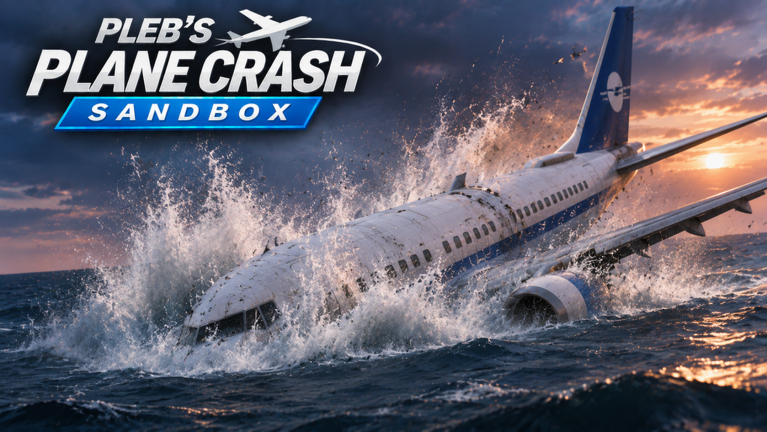
Crash physics is the reason Plebs Plane Crash Sandbox exists. The Roblox ALPHA by WhatAPleb9 ([UPD 7.4] Pleb's Plane Crash Sandbox [ALPHA]) sells piece-by-piece destruction: wings snap, engines tear free, wreckage skids, burns, or sinks, and cockpit warnings scream while you decide whether to save the flight or commit. You play alone (maxPlayers: 1) on Computer or Console, which means every take is a private physics lab.
This guide teaches how to read those breakups — not just trigger them. Pair it with the failure catalog in Trigger Failures and the cinematic pipelines in How to Crash. The embedded video shows a heavy airliner breakup for visual reference; study the debris paths, then recreate the clarity in your own sessions.
Piece-by-piece destruction (what to watch)
A readable crash has separable chapters:
- Cause — bird strike, fire, flame-out, combat hit, or pilot error.
- Asymmetry — yaw, roll, or thrust imbalance while the airframe is still mostly whole.
- Structural loss — engine fall-off and/or wing snap.
- Secondary motion — fire trails, tumbling panels, independent debris.
- Ground or water interaction — skid, cartwheel, burn, sink.
If chapters collapse into one gray instant, simplify the stack. Physics literacy beats spam.
Wings, engines, and wreckage behavior
Wings snapping
A wing snap changes lift and silhouette at once. Expect sudden roll and a fuselage that becomes a tumbling beam. Best studied mid-altitude or on short final so debris still has time to interact with the map. Camera should include the wing root — that is where the story starts.
Engines falling off
Engine tear-offs are mass and thrust events. The departing nacelle often carries fire and its own trajectory. Soften the audience with a fire or bird strike first so the tear-off reads as cause → effect instead of random deletion.
Skid, burn, sink
After impact, wreckage continues the scene:
- Skid — ground slides along runway or field; great for documentary framing.
- Burn — fire persistence sells severity after motion slows.
- Sink — water finales need open lanes; see Maps and Weather.
Linger on secondary motion in replay. Many weak clips cut away the moment the fuselage stops translating — the burn and sink are half the fantasy.
Run versus pilot: how to read physics
Pilot mode teaches force feedback through your hands: how hard STALL hits, how fast SINK RATE escalates, whether PULL UP is recoverable. Use it to discover timings.
Run mode removes input noise so you can watch the authored sequence. If Run looks random, your pre-arm order is random — not the physics engine “lying.”
Reading checklist while either mode plays:
| Signal | Healthy read | Muddy read |
|---|---|---|
| First failure | Visible cause | Plane already shredding |
| Warnings | Support the story | Ignored / never appeared |
| Structural break | One clear event | Simultaneous everything |
| Debris | Stays framed | Exits instantly |
| Finale | Skid/burn/sink readable | Instant dust |
Controls literacy for those warnings lives in Controls.
Replay study method
Treat the crash replay as a lab instrument:
- Watch once at normal speed for emotional read.
- Scrub to the first failure — was it obvious?
- Scrub to the first structural break — did altitude still allow a chapter?
- Scrub impact — which debris stayed on screen?
- Decide one change only: failure delay, map, weather, camera, or airframe class.
- Reshoot. Compare. Keep the clearer take.
The shared crash counter rewards completed wrecks; replay rewards craft. Say which session you are in so you do not farm counters while pretending to study physics.
Stacking failures carefully
Physics compounds. Stacking rules that keep breakups legible:
- Prove flame-out or engine fire alone.
- Add bird strike as narrative cause.
- Only then schedule engine fall-off or wing snap.
- Save multi-side structural chaos for advanced takes.
- If you own Military Intervention, treat guns/bombs/AA/missiles as another “cause” layer — not a reason to ignore order.
Altitude is story time. Too low and chapters merge; too high and debris exits frame before skid/burn/sink. Passengers change mass and stakes but do not replace choreography — roster context: Aircraft.
Airliner versus fighter physics reading
- Airliners — longer timelines, clearer asymmetric thrust, bigger debris poetry. Ideal classroom.
- Fighters — faster roll, tighter windows, wider camera required. Armed damage adds combat causality. Rank spectacle on the Tier List / Best Crash Planes after you can describe why a take worked.
Do not invent named airframe models beyond the airliner and fighter classes you can actually spawn.
Common physics misreads
- Blaming ALPHA when the camera simply missed the tear-off.
- Calling a pancake “bad physics” when no mid-act failure existed.
- Stacking five events and concluding the engine “does not work.”
- Skipping Feedback when a mode truly desyncs from Run — WhatAPleb9 reads messages.
- Installing random physics “fixers” (Scripts is empty for honesty).
- Waiting on Codes for better wreckage — none are public yet.
Practice lab (45 minutes)
- Clear weather, forgiving map — single flame-out crash; replay scrub.
- Bird strike → fire → watch engine behavior; note asymmetry.
- Fire → engine fall-off; camera on the departing nacelle.
- Late wing snap on short final; study skid vs cartwheel.
- Water ditch with staggered flame-outs; watch sink.
- Optional pass take — missile cause into structural loss.
- Storm encore of the clearest clear-air stack.
- Log which sequence moved the crash counter and which looked best.
Cross-links
- Guides Hub — tutorial index
- Trigger Failures — event dictionary you are stacking
- How to Crash — full cinematic pipelines
- Maps and Weather — geometry that frames debris
- Getting Started — when to introduce physics study in hour one
- Updates / Patch Notes — UPD cadence
- Official Links — place and creator
Crash physics rewards patience. Stage causes, protect mid-act asymmetry, let wings and engines separate on camera, then stay for the skid, burn, or sink. When UPD tags climb past 7.4, rerun your favorite lab — ALPHA debris loves new plot twists.
Frequently Asked Questions
Quick answers to the most common questions.
What should I watch for in a good crash breakup?
A clear cause, a mid-act asymmetry, a structural break (wing or engine), then readable skid, burn, or sink on impact.
Should I study physics in pilot mode or Run mode?
Both. Pilot mode teaches timings and warnings; Run mode removes input noise so you can judge the authored sequence on replay.
Why does my wreckage disappear so fast?
Often camera framing, altitude, or map choice. Pull wider, leave more altitude before the break, or use water/runway lanes that keep debris on screen.
How carefully should I stack failures?
Prove each event alone first. Add bird strikes and fires before engine tear-offs or wing snaps so cause and effect stay readable.
What video is embedded on this page?
A verified heavy airliner crash clip (YouTube ID MkRL9PlVNTE) labeled for Plebs Plane Crash Sandbox visual reference — one video maximum per page.